

BinaryGen · Premium resource
The No-Discount Growth Playbook
How to scale email revenue without training your list to wait for a code.
First, who’s writing this
I’m Sajan Dhakal. I started BinaryGen about four years ago, and it began the way most useful things do, with a problem I kept watching people around me run into.
Friends and people in my circle were building real DTC brands. Good products, decent traffic, money going out the door on ads every single month. Nearly all of them had the same blind spot: the customers they had already paid to acquire were quietly walking away, and nobody was doing anything about it. Email sat in the corner of the stack, technically switched on, firing a welcome discount and then nothing.
And that welcome discount is where this particular playbook starts, because for most of those brands, the discount was the strategy. It was the only lever anyone knew how to pull.
One of those accounts was doing around $24,000 a month. Email contributed $1,314 of it. The dashboard read campaigns: $0.00. Not a low number. A zero.
Seven months later the same store did $410,377 in a month, with $104,359 of it from email.
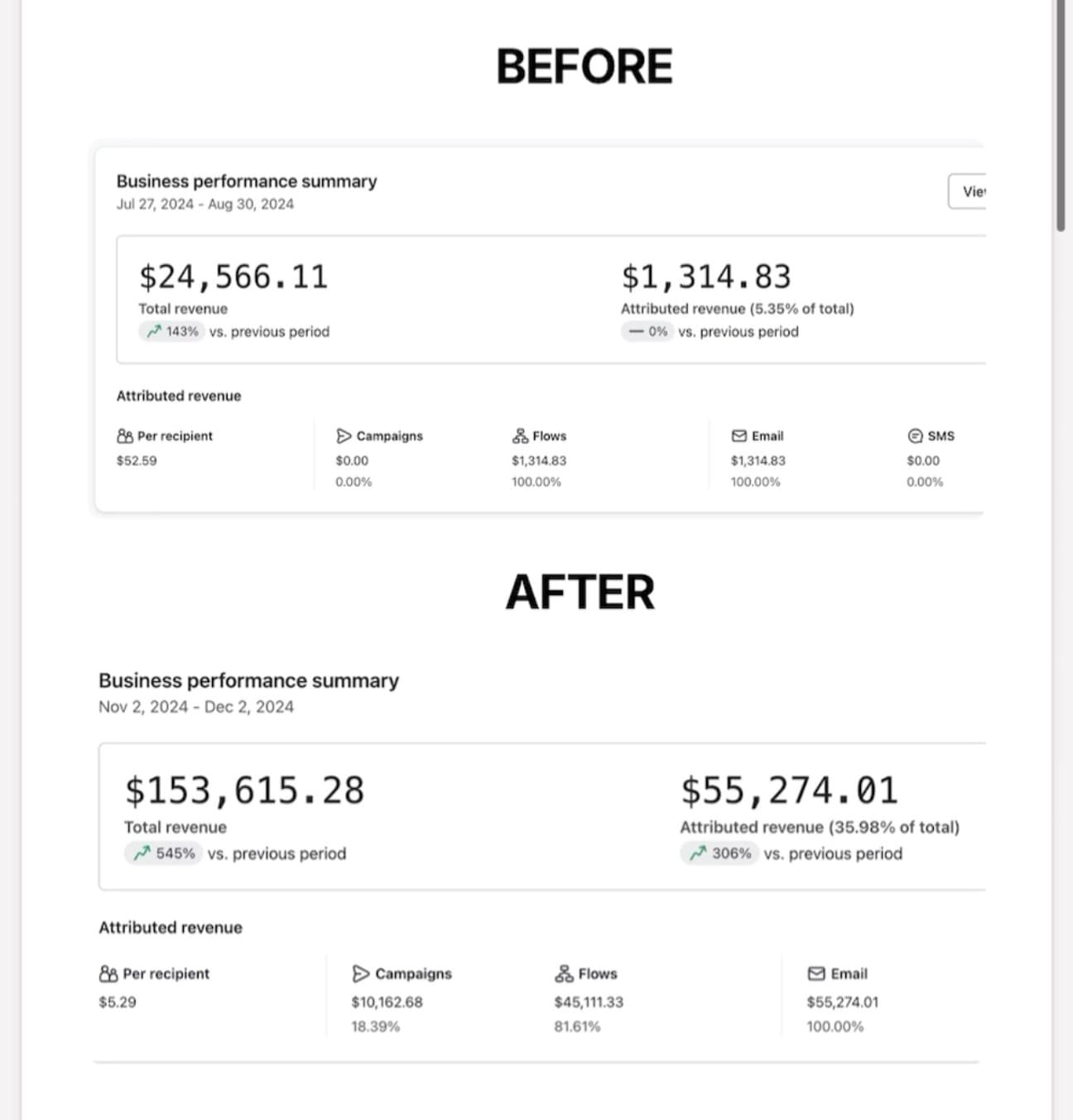
That is the whole reason BinaryGen exists. We’ve since done this work across supplement, wellness and skincare brands in the US and Canada: rebuilding flow architecture, repairing sender reputation on lists up to 272,000 recipients, and dragging email from single digits up to the 30–40% of total revenue it should be producing.
Why nothing here is held back
Because the diagnosis was never the hard part. The execution is.
Everything below is what we actually do, in the order we actually do it. No withheld step, no “book a call to find out the rest.” If you read this and fix your own program, that is a genuinely good outcome and I’d rather you had it.
And if you get three sections in and realise you don’t have the hours to run any of it, you know where to find me.
Let’s get into it.
1. A discount is a loan against future margin
Every discount does two things.
It produces revenue today, which you see immediately and measure obsessively. And it lowers the price the customer believes your product is worth, which you see nine months later in average order value and full-price conversion, by which point nobody connects the two.
That asymmetry in measurement is the whole problem. The benefit is instant and attributed. The cost is delayed and unattributed. Any system measured that way will over-produce discounts.
The benefit of a discount is instant and attributed. The cost is delayed and unattributed. Any system measured that way will over-produce discounts forever, not because anyone decided to, but because nobody is holding the other end of the ledger.
2. The Lesson: what your list has already learned
A brand offering 20% off to new subscribers, then running monthly promotions, has taught its list one rule: never buy at full price, something better is coming.
The list learns this quickly and permanently. Full-price conversion falls, which makes revenue look soft, which prompts another promotion, which reinforces the lesson. By the time anyone notices, the brand has a list that only responds to discounts and a margin structure built around a price nobody pays.
The mechanism nobody models
The damage is not the margin on the discounted order. It is the margin on every subsequent order that would have been full price and now is not, from a customer who has learned to wait.
One discounted order costs you the discount. A discounting habit costs you the difference between your list price and your effective price, forever, across your entire list.
The Lesson. One discounted order costs you the discount. A discounting habit costs you the gap between your list price and your effective price, across your entire list, permanently. You are not running a promotion. You are renegotiating your prices in public.
3. You may be paying people who were already buying
This is the part that reframes everything else in this document.
Last-click attribution credits a promotional email for purchases that would have happened anyway. Someone already intending to buy sees 20% off, uses it, and the campaign takes credit for revenue it did not create, while handing away margin on an order you had already won.
Here is the uncomfortable version: a discount disproportionately attracts the people who were already going to buy. You are not converting the undecided. You are handing margin to the decided, then crediting the campaign for revenue you already had.
What the evidence suggests
Flow revenue is mostly incremental. An abandoned checkout email genuinely recovers orders that would otherwise be lost; a welcome series converts subscribers who needed nurturing. These are high-confidence attributions.
Campaign revenue is only partially incremental: a realistic figure is 40–60% of what gets reported. And promotional campaigns sit at the weak end of that range, because discounts disproportionately attract people who were already going to buy.
Run the test before you argue about it
Suppress 10% of your list from campaigns for two weeks. Measure the revenue difference. That gap is your true incremental impact, and for a heavily discounting brand it is frequently a shock.
A 10–20% holdout is usually sufficient. Run for at least two weeks; shorter tests are noisy. If the confidence interval spans zero, you need a longer test, not a conclusion.
Then do the margin arithmetic
Incremental revenue is not profit. At a 40% contribution margin, €20,000 of incremental revenue is €8,000 of contribution before you subtract the cost of running the promotion, which means break-even incremental ROAS is 1 ÷ 0.40 = 2.5×, not 1×.
Agree the relevant margin with whoever owns finance before you set a target: returns, discounts, fulfilment, and the customer-value horizon all belong in that number. A campaign can generate additional revenue and still lose money.
4. The Leak: your code is on a coupon site right now
A discount code intended for one segment does not stay in that segment.
Codes leak onto public coupon sites, browser extensions, and deal forums. When that happens, revenue still gets attributed correctly to the channel (the code came from your email, so email gets credit), while margin quietly erodes on orders that would have been full price.
This is a failure mode neither last-click nor incrementality testing catches cleanly, because the attribution is technically correct. The order came through the campaign. It just cost you more than the dashboard shows.
The Leak. This one is invisible to every measurement tool you own, because the attribution is correct. The order came through your campaign. It just cost you 20% more than it should have, on a customer who found the code on a deal forum and was never on your list.
The controls
- Unique single-use codes, not a shared one. More work, eliminates the leak entirely.
- Automatic discounts tied to a segment rather than a typed code, where your platform supports it.
- Short expiry windows. A code that dies in 72 hours has less time to propagate.
- Search your own codes monthly. If your welcome code is on a coupon aggregator, your welcome offer is now a public site-wide sale.
5. Kill the welcome discount, keep the conversion
The welcome popup is where most brands start the habit. It does not have to be a discount.
The common property: each has real perceived value, and none tells the customer your list price is fiction.
Free shipping above a threshold is the strongest starting swap for most brands. It reads as a saving, costs less than a percentage discount, and actively raises order value instead of lowering it.
The quiz as a welcome offer
The most underrated replacement: make the value exchange diagnostic rather than monetary. A three-to-seven question recommendation quiz gives the customer a genuinely personalised answer, which is worth more to them than 15% off, and gives you something worth far more than a list signup.
Each answer writes to a Klaviyo profile property you can segment, personalise and automate against. Five questions, five properties, five segments you could not build from behavioural data at all.
Vendor numbers here are uncontrolled and enthusiastic: Octane AI reports skincare brand Geologie moving quiz-completion-to-purchase from roughly 9% to 13%; Klaviyo cites a health-food brand reporting a triple-digit lift in flow revenue after pairing a quiz with segmented flows. Each is single-brand and vendor-stated. Read them as evidence the mechanism works in high-fit categories, not as a forecast.
But the strategic point stands independently of the numbers: a quiz replaces a price-based value exchange with an information-based one, and the information compounds while the discount does not.
6. Sell the mechanism, not the markdown
If you will not compete on price, you have to compete on understanding. Harder, and it compounds. That is the trade.
The pattern that works: a welcome and post-purchase sequence explaining why the product works, not what it costs. Ingredient sourcing. Manufacturing decisions. The specific problem it solves. What actually differs from the cheaper option the customer is weighing.
A customer who understands the mechanism has a reason to pay more. A customer who only knows the price has only the price.
Why this beats a discount on the same send
A discount converts the people already close to buying. Education moves people who were not close yet, which is a larger population and a more durable effect: the understanding persists after the campaign ends, and the discount does not.
7. Five kinds of urgency that never touch price
Discounts get reached for because they manufacture urgency. Urgency is available without them:
- Inventory. Limited stock, genuinely stated. Never fabricate this; customers check, and getting caught is more expensive than any promotion.
- Time-bound access. A drop window, a seasonal item, a production run that ends.
- Cohort. A program, challenge, or batch that starts on a date. Powerful because the urgency is structural rather than manufactured.
- Restock. Back-in-stock notifications carry natural urgency and convert extremely well, because the customer generated the intent themselves.
- Consumption. For consumables, “you are about to run out” is urgency the customer already feels. You are not creating pressure, you are being useful at the right moment.
Each creates a reason to act now that never touches price.
8. Move the basket up instead of the price down
Same revenue effect, opposite margin effect.
- Bundles at a modest saving. A three-pack at a small discount raises AOV and reads as value, without discounting the single unit, which protects the anchor on the SKU you want people paying full price for.
- Free shipping thresholds set just above current AOV, revisited quarterly as AOV moves.
- Gift with purchase above a threshold. Costs you wholesale, reads as retail value. One of the best margin-to-perception ratios available.
- Tiered rewards. Spend more, unlock something non-monetary: early access, a community, a service.
9. Discounting is what you do when you don’t know them
The reason most brands discount is that they have nothing else to say. A generic email to a generic segment has no lever except price.
This is where the data work pays for itself. With declared preferences and predictive properties in place, you can send a message that is relevant enough to convert without an offer attached:
- Predicted next purchase date: reach someone while the decision is live, which needs no discount
- Declared concern or goal from a quiz: speak to the specific problem rather than the category
- Churn risk crossing a threshold : intervene with a check-in rather than a code
- RFM segment migration: catch a lapsing customer weeks before the discount-or-lose-them moment
A discount is what you use when you do not know enough about someone to be relevant. Fix the knowledge problem and the discount becomes optional.
A discount is what you reach for when you have nothing specific to say. Know someone’s goal, their concern, or their reorder date, and you have a message that converts on relevance. Know nothing, and price is the only lever left.
10. Six rules for when you have to discount anyway
Some moments require it. Black Friday exists.
- 01Never discount your warm segment. They were converting anyway, so the discount is pure margin loss on revenue you already had. Your best offer goes to the coldest tier that still has a pulse: people who need a reason to return, not people who need a nudge.
- 02Time-box hard and keep the promise. A sale that quietly extends teaches the list that your deadlines are fake, and it undermines every future time-bound send.
- 03Discount a bundle, not the hero SKU. Protects the anchor price on the product that matters.
- 04Cap at twice a month, absolute maximum. Past that the lesson sticks.
- 05Never discount to save a cancellation or a failed payment. Those customers were not leaving over price, and discounting resets their anchor permanently.
- 06Use unique codes. See section 4: a shared code is a public sale with extra steps.
11. Three numbers that catch the damage early
Blended conversion rate hides all of this. Three numbers instead:
Full-price conversion rate. Orders placed with no code applied, as a share of total. If this falls while revenue holds, you are training your list and the bill arrives later.
Average order value on non-promotional sends. The earliest visible symptom of anchor damage. It moves months before revenue does, which makes it the leading indicator worth watching weekly.
Incremental contribution margin per campaign. Not revenue. Revenue minus discount, minus COGS, minus fulfilment, adjusted for the incrementality factor from your holdout. This is the only number that tells you whether a promotion made money.
The quarterly review
Plot full-price conversion rate and promotional frequency on the same chart, over eighteen months. If one rises as the other falls, you have your answer and it does not require further debate.
12. What this actually costs you
A no-discount program grows more slowly at first. There is no version of this where you remove discounts and revenue rises the following month. Anyone who tells you otherwise is selling something.
What you get instead:
- Margin that survives scale
- A list that responds to product rather than price
- The ability to run a promotion that actually works when you genuinely need one, because it will be the first in six months rather than the fourth this quarter
- An acquisition funnel that is not structurally dependent on your cheapest customers
The transition
Do not stop cold. Sequence it:
- Month 1. Swap the welcome discount for a threshold or diagnostic offer. Leave existing campaign cadence alone. Start measuring full-price conversion rate.
- Month 2–3. Run a holdout on promotional campaigns specifically. Get the real incrementality number before you argue with anyone about frequency.
- Month 4–6. Cut promotional frequency using the holdout data as the argument. Replace the removed sends with education and mechanism content, not silence.
- Month 6+. Build the personalisation infrastructure (zero-party capture, predictive triggers) that makes relevance a permanent substitute for price.
The one-line version
You are not choosing between discounting and not discounting. You are choosing between paying for revenue now and owning it later, and most brands make that choice without ever seeing the second number.
Run the holdout before you argue about it
The fastest way to settle whether your discounting is working is not a debate. It is a two-week test on 10% of your list.
Most brands discover their promotional campaigns are far less incremental than the dashboard claims, and once that number exists, every other decision in this playbook makes itself.
Book a 15-minute account review →Bring your Klaviyo. We will set up the holdout, agree the contribution margin to measure against, and pull your full-price conversion rate over the last eighteen months. If your anchor is intact, that is what you will hear.