

BinaryGen · Premium resource
The Subscription Retention Playbook
For DTC brands where the next order is already scheduled, and the job is stopping it from being cancelled.
Who’s writing this
I’m Sajan Dhakal, founder of BinaryGen.
I started BinaryGen after seeing the same problem across DTC brands: founders were spending heavily to acquire customers, while the customers they already paid for were quietly disappearing.
One brand was doing around $24k/month, with just $1,314 coming from email. Campaign revenue was literally $0.
Seven months later, that same store did $410k in a month, with $104k from email.
That’s why BinaryGen exists. Since then, we’ve worked with supplement, wellness and skincare brands across the US and Canada, rebuilding retention systems, fixing deliverability, and turning email into a much bigger revenue channel.
Why I’m giving this away
Because knowing what’s broken was never the hard part. Actually fixing it is.
Everything below is the same process we use with clients, step by step. No hidden “book a call to find out more.”
If you can implement it yourself, great. And if you get halfway through and realise you’d rather have someone else handle it, you know where to find me.
The latest case study comes first, followed by the full playbook.
Case study: The $75,000 Blind Spot
Supplement brand · Subscription · Shopify + Klaviyo
Eight weeks. $0.00 → $57,571.60.
Before · 37 days, Jun 25 – Jul 31
Total revenue
$74,936.77
Growth
+158%
vs. previous period
Email revenue
$0.00
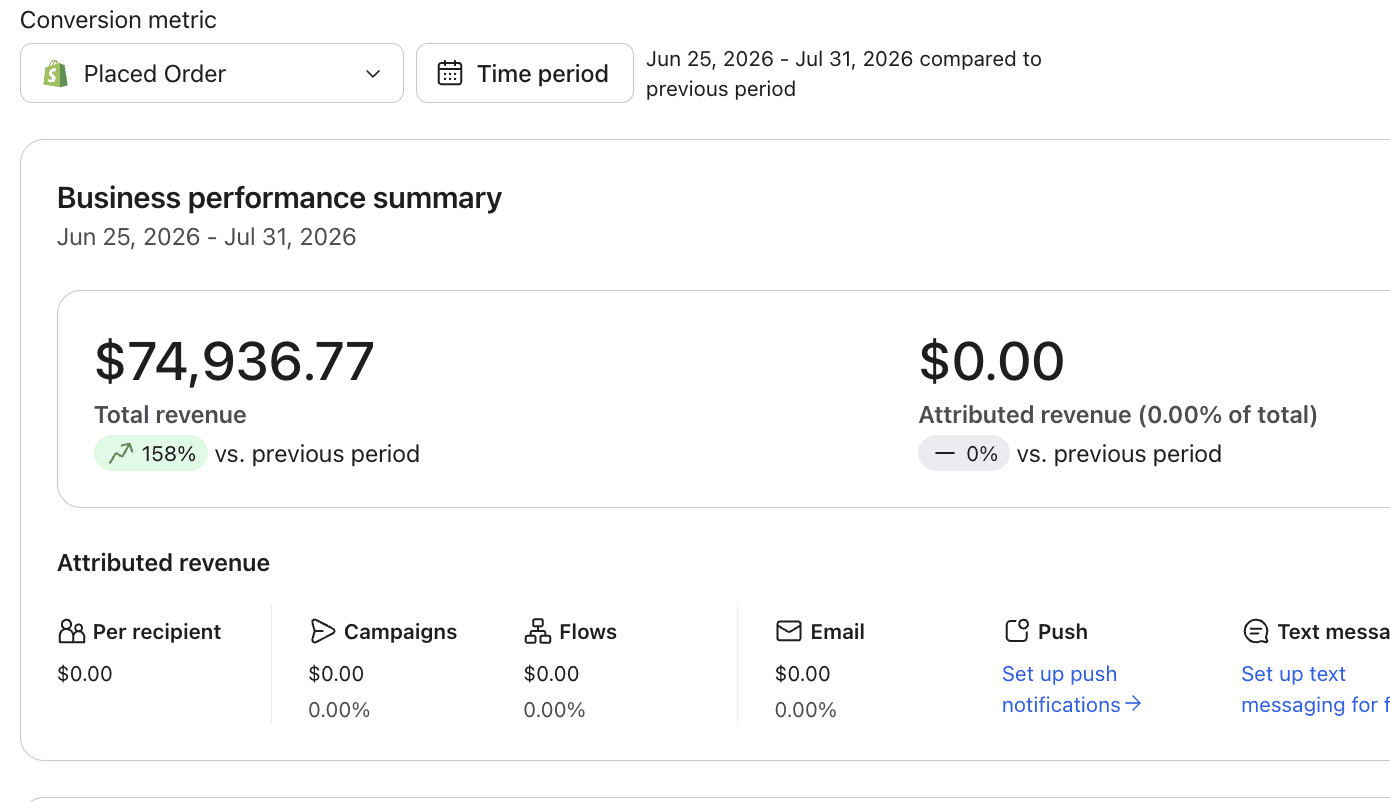
Revenue up 158%. Email at absolute zero. Not underperforming: absent.
What that meant in practice
The Blind Spot. The missing revenue was never the problem. The missing floor was. Growth hides a retention hole perfectly, then stops hiding it at the worst possible moment.
Why we could not just email the list
Reads as spam. No record to judge it
Signals earned. Placement holds
The Cold Start Problem. The risk is not list fatigue. It is teaching every inbox provider to distrust your domain in week one.
The build
- 01 · Days 1–7
Authenticate + warm
- 02 · Days 7–21
Dunning sequence
- 03 · Days 14–35
Post-purchase spine
- 04 · Days 21–56
Widen + campaign
Payment recovery ships before promotion, because it recovers customers who never chose to leave.
After · 57 days, Aug 1 – Sep 26
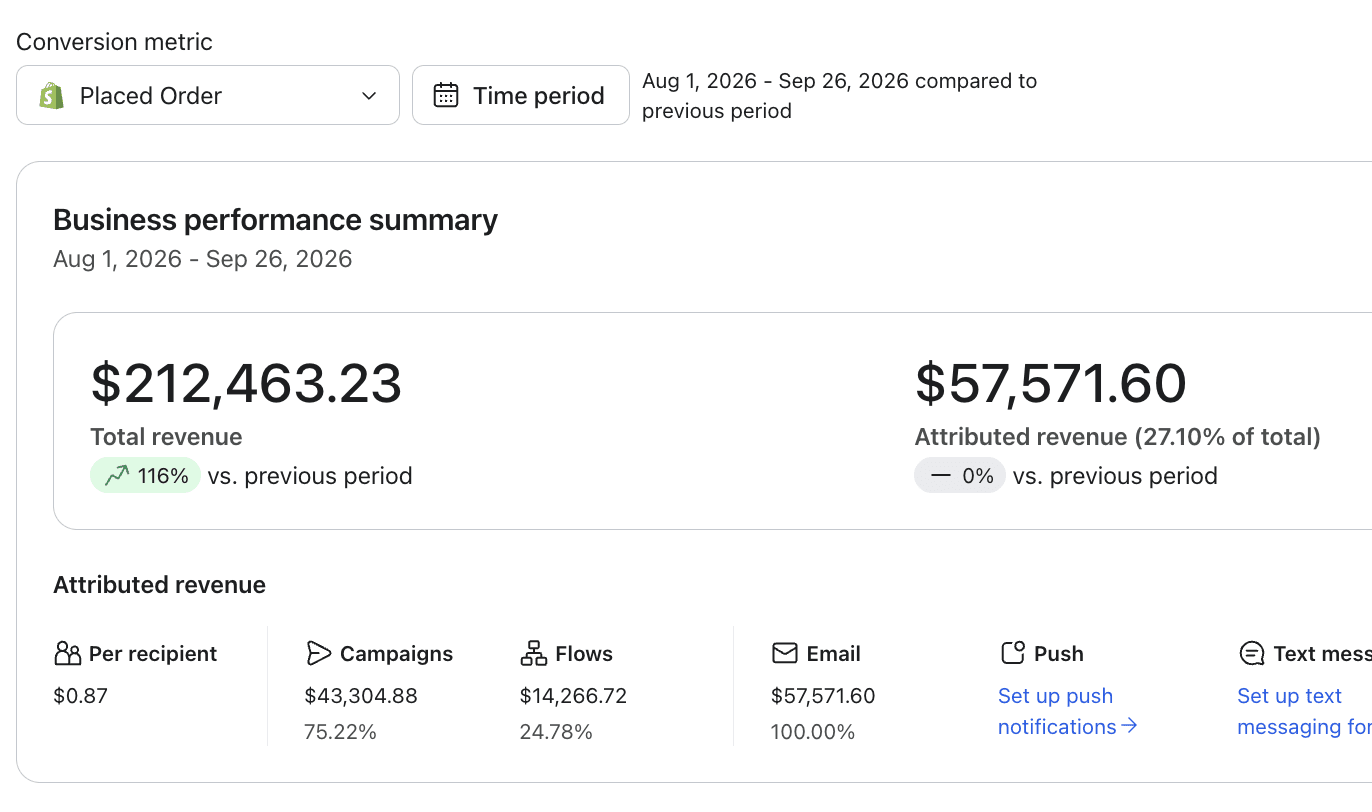
Different window lengths, so per day:
Roughly $368,000 a year from a channel that produced nothing eight weeks earlier.
The curve
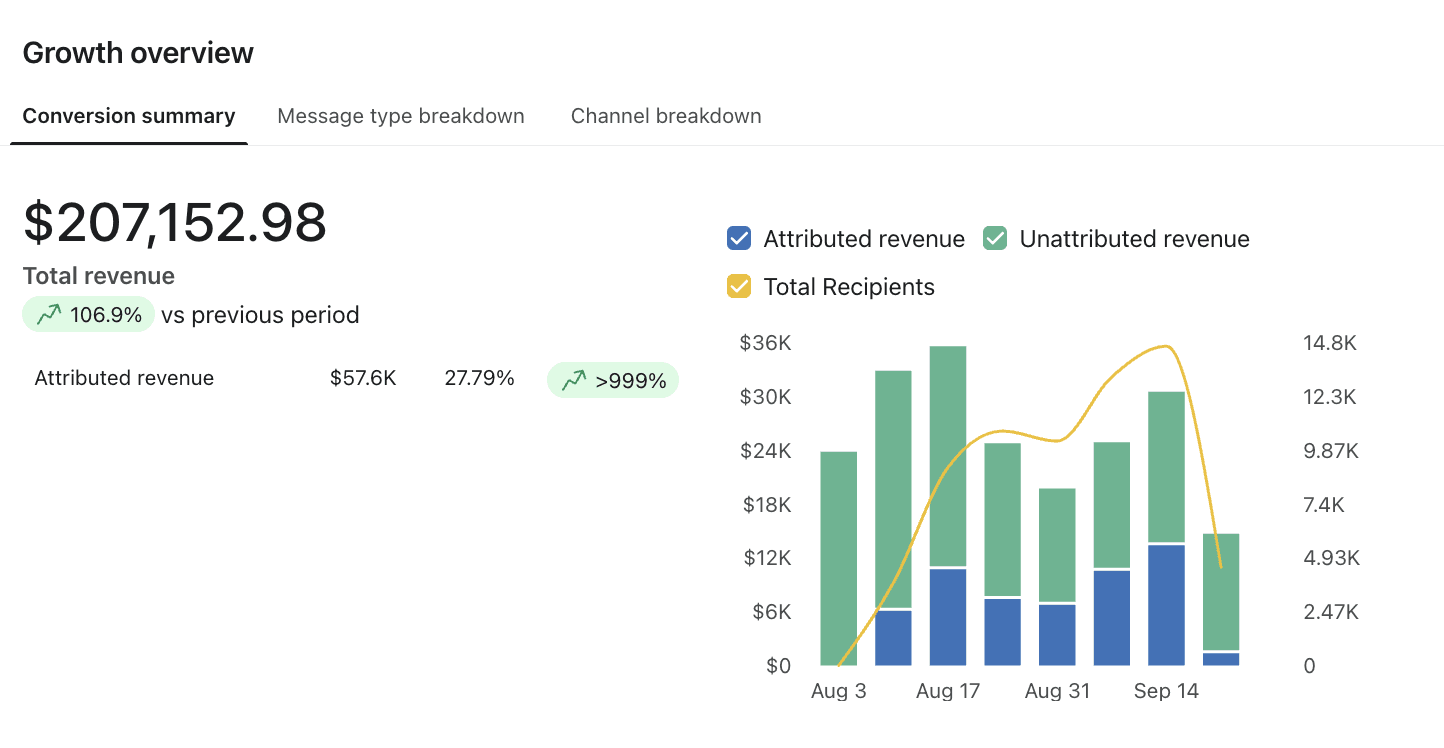
The recipient line drops on purpose. Volume pulled back after widening: a controlled ramp.
Four honest readings
Email did not cause the growth
Revenue was already +158%. Email decides whether it is keepable.
75% campaigns is right at week 8
And wrong at month 6. That ratio has to invert.
$0.87 per recipient is healthy
Not spectacular. Per-recipient flatters small lists.
Eight weeks is a direction
No seasonal dip or full cycle tested yet.
Still open
- Flows at 25% must invert. Campaigns are labour, flows are an asset.
- SMS and push at zero. Both dashboards still show the setup prompts.
- Cycle-two data is not in. The number that will actually decide this account.
1. The Inversion
In a one-time-purchase business, email’s job is to produce the next order. In a subscription business, the next order is already scheduled. Email’s job is to stop it from being cancelled.
That inversion changes every priority. Most subscription brands run an email program designed for a non-subscription business (welcome, abandoned cart, promotional campaigns) then wonder why churn does not move. The flows are competent. They are aimed at the wrong event.
The program should be organised around three questions:
- 01What is about to cause a cancellation that we can prevent?
- 02What is about to cause a failed payment that we can pre-empt?
- 03What makes cycle two feel different from cycle one?
Everything below serves those three.
2. The Silent Third
Involuntary churn (failed payments, expired cards, insufficient funds, issuer declines) is churn you never earned. The customer did not decide to leave. A card expired.
This is the most under-attended revenue leak in subscription commerce, and the reason is structural: it looks like a billing problem, so it sits with finance or ops, and the retention team never touches it.
Pull this number before anything else: involuntary churn as a percentage of total churn. Above 20% and your dunning sequence is the cheapest revenue available to you this quarter. No amount of copy improvement elsewhere will match it.
Why it compounds quietly
A failed payment does not just cost you that cycle. It ends a subscription with months or years of remaining value, for a customer who was, by revealed preference, happy. They were still subscribed. They were still paying. Nothing about the relationship had broken.
Every other intervention in this document argues someone out of a decision. Dunning is the only one where there was no decision to argue with.
The Silent Third. In most subscription accounts, a large share of cancellations were never decisions. They were expired cards. You are losing customers who wanted to stay, and it lands in your churn number as though they walked.
3. Dunning is a retention flow, not a receipt
Most dunning sequences are a billing notification sent three times. Here is what a retention-grade one looks like.
Framing first
Never say “payment failed.” Say the card needs updating. The first implies the customer did something wrong, or worse, that they have no money. The second implies routine admin. The conversion gap between those two framings is larger than anything you will achieve rewriting the body copy.
Two phrasings, wildly different outcomes. “Payment failed” tells a customer they did something wrong, or that they are broke. “Your card needs updating” tells them a date expired. Same event. Only one of them gets clicked.
The sequence
Rules
- Never discount inside a dunning sequence. The customer did not ask for a lower price; they have a card problem. Discounting gives away margin on a subscriber who was not leaving, and teaches the list that letting a card expire produces a discount.
- Use a different sender profile or subdomain. Dunning is quasi-transactional and belongs in the primary inbox, not Promotions. Sending it from your marketing subdomain buries it beside your campaigns.
- Retry schedule matters more than copy. Coordinate email timing with your processor’s retry logic. An email arriving after the final retry has fired is a notification, not an intervention.
4. The Trade Nobody Takes
The counterintuitive one, and most brands refuse it.
Telling customers they are about to be charged will raise voluntary cancellations. That is true, measurable, and exactly why the notice does not get sent.
Send it anyway.
A surprise charge produces a customer who disputes it, marks you as spam, and never returns. At scale those complaints are a deliverability problem: they accrue against your sending domain and degrade inbox placement for your entire list, including the people who love you.
A cancellation produces a customer you can win back.
The Trade Nobody Takes. You give up a handful of clean cancellations. You get back every chargeback, every spam complaint and every furious support ticket a surprise charge would have produced, plus the domain reputation those complaints were quietly eating.
How to send it
Five to seven days before the charge. Include what was delivered since the last one: a renewal notice is one of the few moments where reminding someone why they subscribed is welcome rather than promotional.
Put skip and pause directly in the email. If someone is over-supplied you want them skipping, and you want them discovering that option from you rather than from a cancellation page.
5. The switch almost nobody flips
The most underused capability in the Klaviyo stack, available to any account with a connected store and enough order history. Three properties matter:
- Churn Risk Prediction. Flags customers with high predicted churn probability before they lapse, so winback becomes proactive rather than reactive. The score exports as a number between 0 and 1: 0.45 means a 45% risk.
- Predicted Customer Lifetime Value. Projects future value from behaviour, so you can treat high-predicted-CLV customers with VIP intensity before they have hit a spending threshold.
- Expected Date of Next Order. The trigger almost nobody uses. A date-based flow firing just before the predicted reorder date reaches the customer while the decision is live.
Availability
Segmenting on CLV requires at least 500 customers to have placed an order: not 500 active profiles, 500 people who actually bought. The predictive suite generally needs a connected store and roughly 500+ orders of history.
The flows to build on it
- Proactive save. Triggers when a high-value customer crosses a churn-risk threshold, before they have missed anything. The message is not a discount: it is a check-in, a usage tip, or a frequency adjustment.
- Segment migration alert. Fires when a customer moves from a healthy RFM segment into an at-risk one. The transition is the signal, not the absolute state.
- Pre-emptive reorder. Date-triggered on Expected Date of Next Order, minus a few days.
One caution: a large base of one-time purchasers drags average churn risk upward. That is a signal about your post-first-purchase retention, not about the model.
6. The Cycle-Two Cliff
Days-since-signup is a weak variable. Cycle position is the strong one.
The cycle-two problem
Churn clusters hard at cycle two, and the cause is almost always the same: the second delivery felt identical to the first. Novelty is gone, habit has not formed, and nothing in the experience changed.
Whatever your product, something about cycle two should be different. A new variant. A different piece of education. An unlock. A milestone acknowledgement. The mechanism matters less than the customer registering a change.
The Cycle-Two Cliff. Cycle one is curiosity. Cycle three is habit. Cycle two is the gap between them, and it is where subscription businesses quietly bleed out, because the second delivery felt exactly like the first.
Most brands spend their creative energy on the welcome sequence, where the customer is already maximally engaged, and send nothing distinctive at the one moment where the relationship is actually decided.
7. Kill every email that isn’t first value
A new subscriber does not need to understand your brand. They need to experience the thing they subscribed for, quickly.
Cut every email in the first two weeks that does not move them toward first use. Brand story, founder letter, category education, sustainability commitments: all of it waits until cycle two.
Not because that content is bad, but because it competes for attention with the only job that matters in week one. In subscription, a customer who has not experienced value before the second charge is a customer who cancels at the second charge.
The test
Write down the single moment where your customer first gets what they paid for. Count how many emails you send before that moment, and how many of them help them reach it. For most brands the ratio is bad.
8. The Ladder: five rungs before “cancel”
Most brands put all their retention effort into the cancellation page and none into the sequence around it. In strict order:
- 01Pause. Always first. Costs nothing, retains the relationship, and a substantial share of pauses resume on their own.
- 02Skip. For consumables where the customer is over-supplied. Frequently the real problem, misdiagnosed as dissatisfaction.
- 03Change frequency. Frequency mismatch is among the most common true causes of cancellation and the easiest to fix.
- 04Change the product. Different variant, size, or tier.
- 05Cancel cleanly, into a winback flow that does not start for 30 days.
The exit survey is a retention asset
One question on the cancellation flow, structured options, feeding a Klaviyo profile property. Within a quarter you will know which rungs actually matter for your brand and can weight the ladder accordingly.
Most brands either do not ask, or ask in free text nobody reads.
9. The Anchor Tax
A save-offer discount converts well and costs far more than it appears to.
You have permanently reset that customer’s price anchor. They now know the real price is lower. Every future renewal is judged against the discounted one, and the moment you return them to full price you get the cancellation you postponed.
You have also taught them that threatening to cancel produces a discount. Customers share this.
The Anchor Tax. A save-discount does not cost you one month’s margin. It costs you the gap between your real price and your discounted price on every renewal that customer ever makes again, because you just told them what the product is actually worth.
Pause and skip cost nothing and leave the anchor intact. If you must use an incentive, make it non-monetary: an upgrade for one cycle, an add-on, early access. Perceived value, no price implication.
10. The questions behaviour cannot answer
Behavioural data tells you what someone did. It cannot tell you why, and in subscription the why is the retention lever.
Some segments are structurally impossible to build from behavioural signals alone. You cannot infer skin type from browsing behaviour. You cannot reliably infer primary concern from purchase history. No observational signal tells you whether someone is buying as a gift. These have to be asked.
How it works mechanically
Quiz answers become Klaviyo profile properties you can segment, personalise and automate on from the same place you run every other channel: profile property writes for the answers, event emission for the quiz moments.
A well-built recommendation quiz asks three to seven diagnostic questions, each mapping to a specific custom property. Five questions, five properties, five segments you could not build yesterday.
What to ask a subscriber
For subscription, the highest-value questions predict the cancellation reason:
- What outcome are you hoping for? Sets the expectation you will measure against at cycle two.
- How often do you expect to use this? Predicts frequency mismatch before it causes a cancel.
- What have you tried before? Tells you which comparison you are being judged against.
Each answer becomes a branch in onboarding and a variable in the save flow.
The honest read on quiz case studies
Vendor numbers here are enthusiastic. Octane AI’s case study on skincare brand Geologie reports roughly a 50% lift in quiz-completion-to-purchase conversion, cited as a move from about 9% to 13%. Klaviyo’s own write-ups cite a health-food brand reporting a triple-digit increase in flow revenue after pairing a quiz with segmented flows.
Each is vendor-stated, single-brand, no control group. Treat them as illustrations of mechanism, not forecasts. The cross-category pattern (beauty, skincare, supplements, apparel) is more useful than any single percentage.
11. Monthly churn is a lie your dashboard tells
Monthly churn is an average, and averages hide the thing you need to see.
Read the cohort curve instead
Plot retention by signup cohort against cycle number. A program that works flattens after cycle two. A program buying growth shows a stable monthly churn figure while each successive cohort retains worse than the last, and that divergence is invisible in the blended number until it is severe.
The two secondary metrics
- Involuntary churn as a share of total. Above 20% means dunning is your cheapest win.
- Cycle-two survival rate. The single number most predictive of long-run subscription economics.
12. The number that makes your reporting honest
The part almost no agency will show you, because it makes the attributed-revenue number smaller.
Why attributed revenue overstates
Last-click credits email for purchases that would have happened anyway. Someone already intending to buy clicks the email because it was there; the email takes the credit but changed nothing.
Flow revenue is mostly incremental: an abandoned checkout email genuinely recovers orders that would otherwise be lost. Campaign revenue is only partially incremental, and a realistic figure is 40–60% of what gets reported.
How to run one
Suppress 10% of your list from campaigns for two weeks and measure the revenue difference. That gap is your true incremental impact. Run it quarterly.
A 10–20% holdout is usually enough; larger gives more statistical power at the cost of more forgone revenue. Run user-level tests for a minimum of two weeks: shorter tests produce noisy results. Watch the confidence interval: a positive result whose interval spans zero is not significant, it means you need a longer test or a bigger holdout.
Why it is worth the discomfort
Once you apply incrementality adjustments, email and SMS economics still beat paid channels by something like 5–10x rather than 15–25x. Still an overwhelming advantage.
You lose a flattering number and gain one you can make decisions with. For a subscription brand deciding between dunning, campaigns, and acquisition, that distinction is the whole game.
13. The first 90 days
- Days 1–14. Pull involuntary churn as a share of total. Pull the cohort retention curve. Rebuild dunning. Check SPF, DKIM and DMARC on a dedicated sending subdomain.
- Days 15–30. Ship the pre-renewal notice. Build the cancel ladder with pause and skip surfaced before any offer. Add the one-question exit survey.
- Days 31–60. Switch on predictive properties. Build the proactive save flow on churn risk and the pre-emptive reorder flow on Expected Date of Next Order. Rebuild onboarding around time-to-first-value.
- Days 61–90. Ship cycle-two differentiation. Stand up zero-party capture. Run the first holdout test.
Start with the cheapest number
Before rebuilding anything, pull one figure: involuntary churn as a percentage of total churn.
If it is above 20%, your dunning sequence is worth more this quarter than every other play in this document combined, and it is a week of work, not a quarter.
Book a 15-minute account review →Bring your billing data and your Klaviyo. We will split voluntary from involuntary churn, read your cohort curve for the cycle-two drop, and tell you which of the two is actually costing you more. If dunning is already tight, we will say so and move to the cancel ladder.